
In the competitive world of swimwear, visual impact is everything. When a customer scrolls through Instagram or walks past a boutique window, they are often drawn to a garment that looks “perfectly composed”—where a tropical leaf curves exactly along the waistline or a sunset motif centers perfectly across the chest.
This isn’t a happy accident. It is the result of Placement Printing.
For emerging swimwear brands, understanding the difference between a standard repeating pattern and a placement print can be the difference between a product that looks “mass-market” and one that looks “high-end designer.”
Defining the Placement Print
At its most basic, a placement print (also known as a “positioned print” or “engineered print”) is a graphic or pattern designed to sit in a specific, predetermined location on a garment.
Placement Print vs. All-Over Print (AOP)
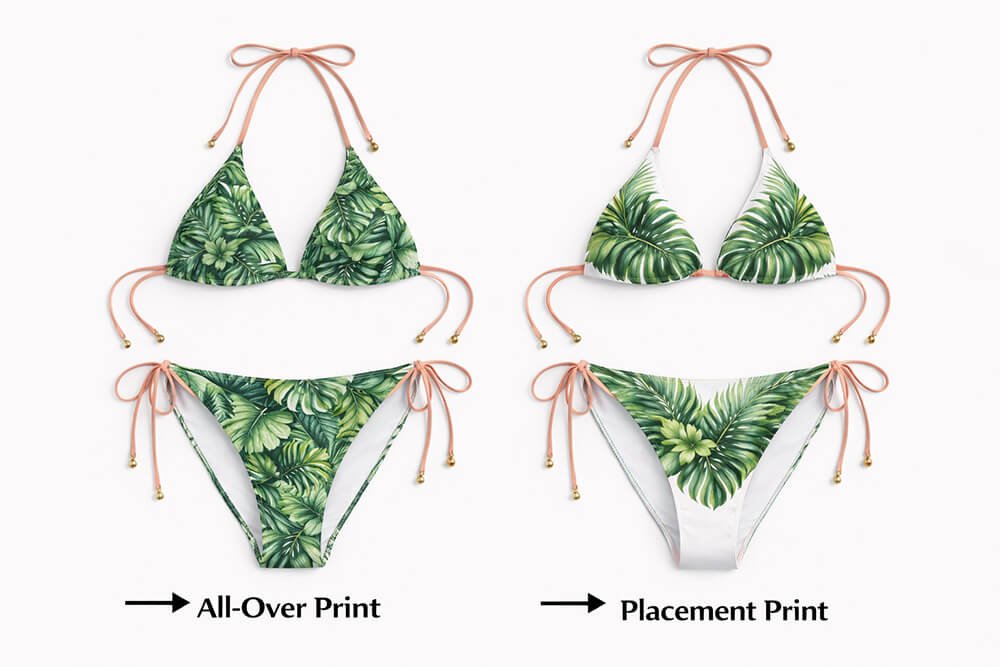
To understand placement printing, you must first understand its opposite: the All-Over Print (AOP).
All-Over Print (AOP): The design is a repeating “tile” printed onto a continuous roll of fabric. When the factory cuts the bikini pieces out of that roll, the pattern falls randomly. On one bikini, the flower might be on the left hip; on another, it might be on the right.
Placement Print: The design is “mapped” directly onto the digital pattern pieces. Every single swimsuit in that size will have the flower in the exact same spot.
Comparing AOP and Placement Prints
| Feature | All-Over Print (AOP) | Placement Print |
| Setup Cost | Low to Moderate | High (Design Labor) |
| Fabric Yield | High (Pieces “nested” tightly) | Low (Specific layout required) |
| Visual Look | Random / Organic | Intentional / Engineered |
| Complexity | Simple | High |
| Best For | Florals, Polka Dots, Animal Prints | Logos, Large Motifs, Border Prints |
Why Swimwear Brands Choose Placement Prints
Placement printing is more expensive and technically difficult than AOP, so why do brands do it? It comes down to Visual Engineering.
Uniqueness
Placement prints are built for a specific pattern, not repeated across the fabric. This gives brands more control over exactly where the artwork sits on the body, making each style look intentional and harder to copy. It’s also ideal for signature looks, capsule drops, and collaborations.
Brand Identity and Logos
If your brand relies on a large, central logo or a specific signature motif (like a designer’s signature across the back), placement printing is the only way to ensure that branding isn’t cut in half or hidden under an armpit.
The Luxury Perception
Because placement prints require extra setup, accurate cutting, and tighter quality control, the final product often feels more elevated than an all-over print.
Sublimation Placement Print Process
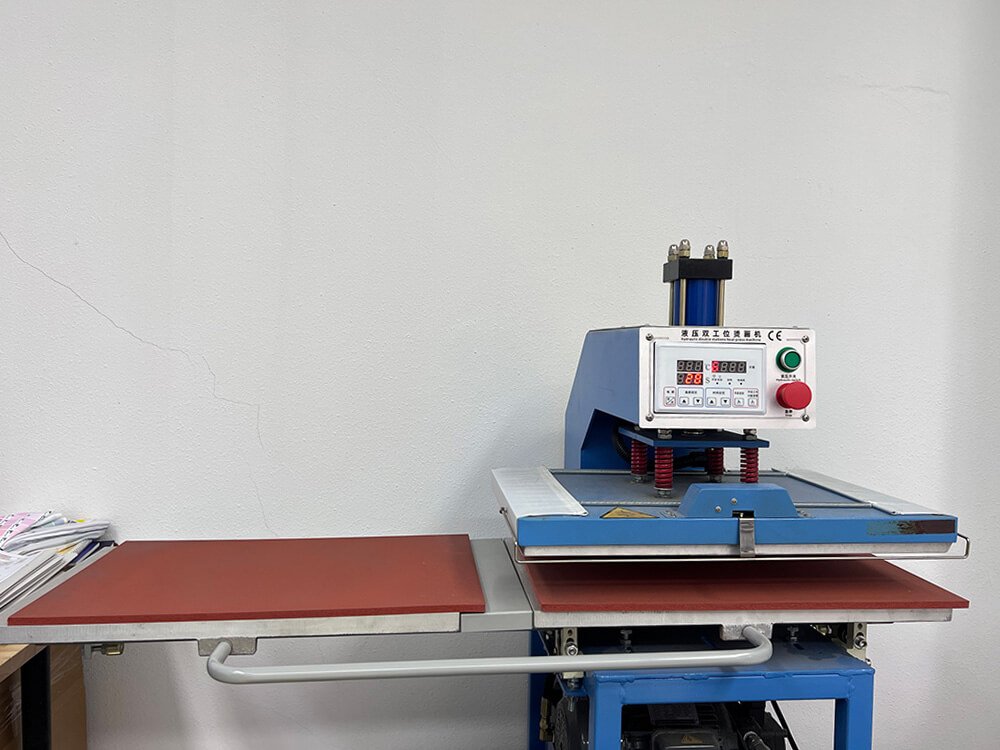
The production of prints requires close collaboration between fashion designers and factories.
1. Cut the fabric panels
Cut the fabric pieces for each panel. Many factories leave a small extra margin so the edges can be trimmed clean after transfer.
2.Print the artwork on sublimation paper
Print the placement artwork on transfer paper, usually mirrored, with enough bleed beyond the cut lines.
3.Align the paper on the fabric panel
Place the printed paper on top of the matching fabric piece and align it using marks (center lines, notches, key points).
4.Heat press to transfer the print
Apply heat and pressure to transfer the ink from paper to fabric. After transfer, trim if needed, then move to sewing.
Key Considerations for Placement Printing:
Fabric Choice: Not all fabrics are suitable for sublimation printing. For swimwear, polyester fabrics are suitable for sublimation printing, while nylon fabrics are suitable for DTG printing.
Artwork quality and file setup: Use clean, high-resolution artwork (vector is best). Small text, thin lines, and gradients need extra care because any blur becomes obvious once the suit is stretched.
Accurate placement on real pattern pieces: Placement prints must be engineered on the actual pattern, not guessed from a flat mockup. Add proper bleed beyond cut lines to avoid white edges, and confirm whether the design must be centered or mirrored.
Challenges of Placement Prints
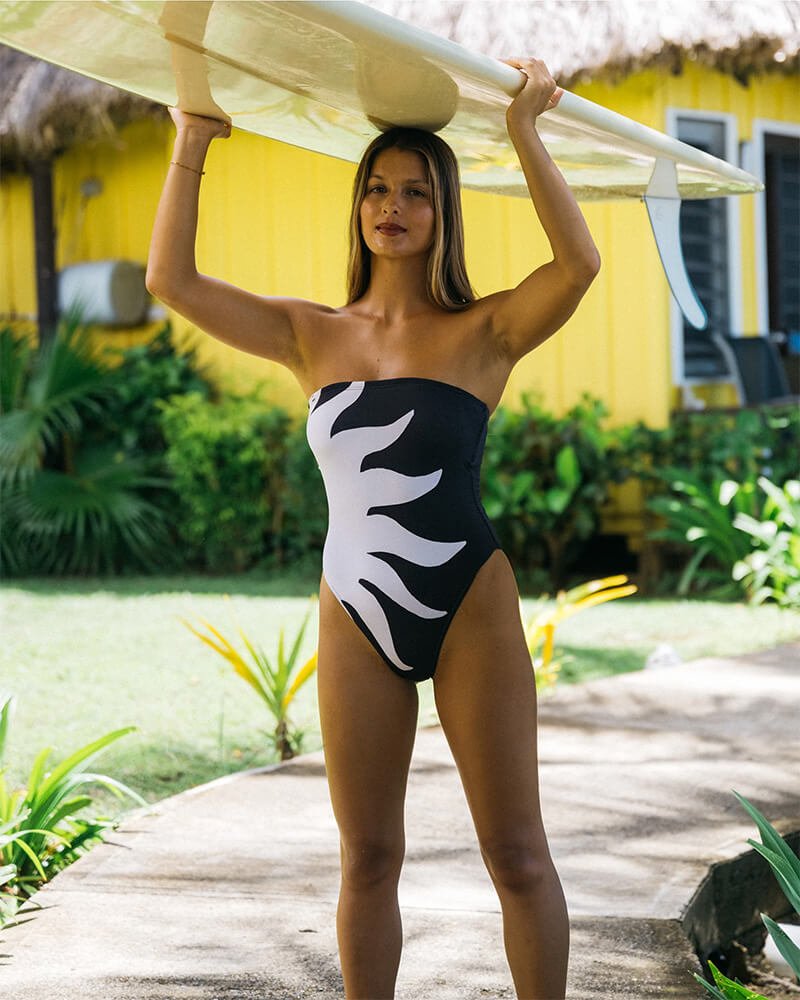
The biggest challenge with placement printing—and the reason many small brands struggle with it—is Grading.
In the garment industry, “grading” is the process of turning a Size Small into a Size XL. In a standard AOP garment, the flower pattern just stays the same size while the fabric piece gets bigger.
With a placement print, the artwork must be resized or repositioned for every single size.
- Scenario: You have a large sun motif in the center of a one-piece.
- On a Size XS: The sun might take up 80% of the chest.
- On a Size XXL: If you use the same sun file, it might look tiny and “lost” in the center of the larger garment.
To do this properly, the Patternmaker must create separate print files for every size.This dramatically increases the pre-production costs and the margin for error at the factory level.
Design Tips for Mastering the Placement Print
To make your placement print look world-class, keep these professional tips in mind:
Avoid the “Critical Zones”: Don’t place complex, high-contrast imagery directly over the nipple or the crotch area, as the “stretch” in these areas can lead to unflattering distortions.
Use “Bleed” Areas: Always extend your print 1-2cm past the edge of the pattern line. This allows for slight shifting during the cutting process so you don’t end up with a random white line at the seam.
Think 3D: Remember that the body is not a flat piece of paper. A print that looks great on a screen might “wrap” around the side of the body and disappear when worn. Use a 3D rendering tool or a physical mannequin to check your placements.
Mirroring: In bikini bottoms, symmetrical placement prints on the hips can create a balanced, aesthetic “V” shape that is highly popular in fitness and competition swimwear.
Sustainability and Placement Printing
Is placement printing eco-friendly? It’s a double-edged sword.
The Positive: Digital sublimation used for placement prints uses significantly less water than traditional screen printing or vat dyeing. It also produces less ink waste because the printer only puts ink where the pattern is.
The Negative:The fabric waste (off-cuts) is generally higher.
Is Placement Printing Right for Your Collection?
Before you commit to this process, ask yourself these three questions:
Does my design require it?
If you just want a pretty floral pattern, stick with AOP. If you want a specific “landscape” to flow across the body, go with placement.
Can my budget handle the “Per Piece” increase?
Expect a 20-40% increase in manufacturing costs.
Is my factory tech-savvy? Not all factories have the CAD/CAM capabilities to handle complex placement mapping. Select swimwear factories offering sublimation printing services.
Conclusion
Mastering the placement print is a rite of passage for a swimwear brand. It moves your brand from the “commodity” category into the “designer” category. While the technical hurdles—specifically regarding grading and alignment—are significant, the result is a garment that feels bespoke, flattering, and undeniably premium.
If you’re planning your next print collection, as a professional swimwear manufacturer, we can help you achieve perfection—whether it’s spot printing or all-over printing.